[syndicated profile] earthobservatory_iod_feed

Posted by Michala Garrison

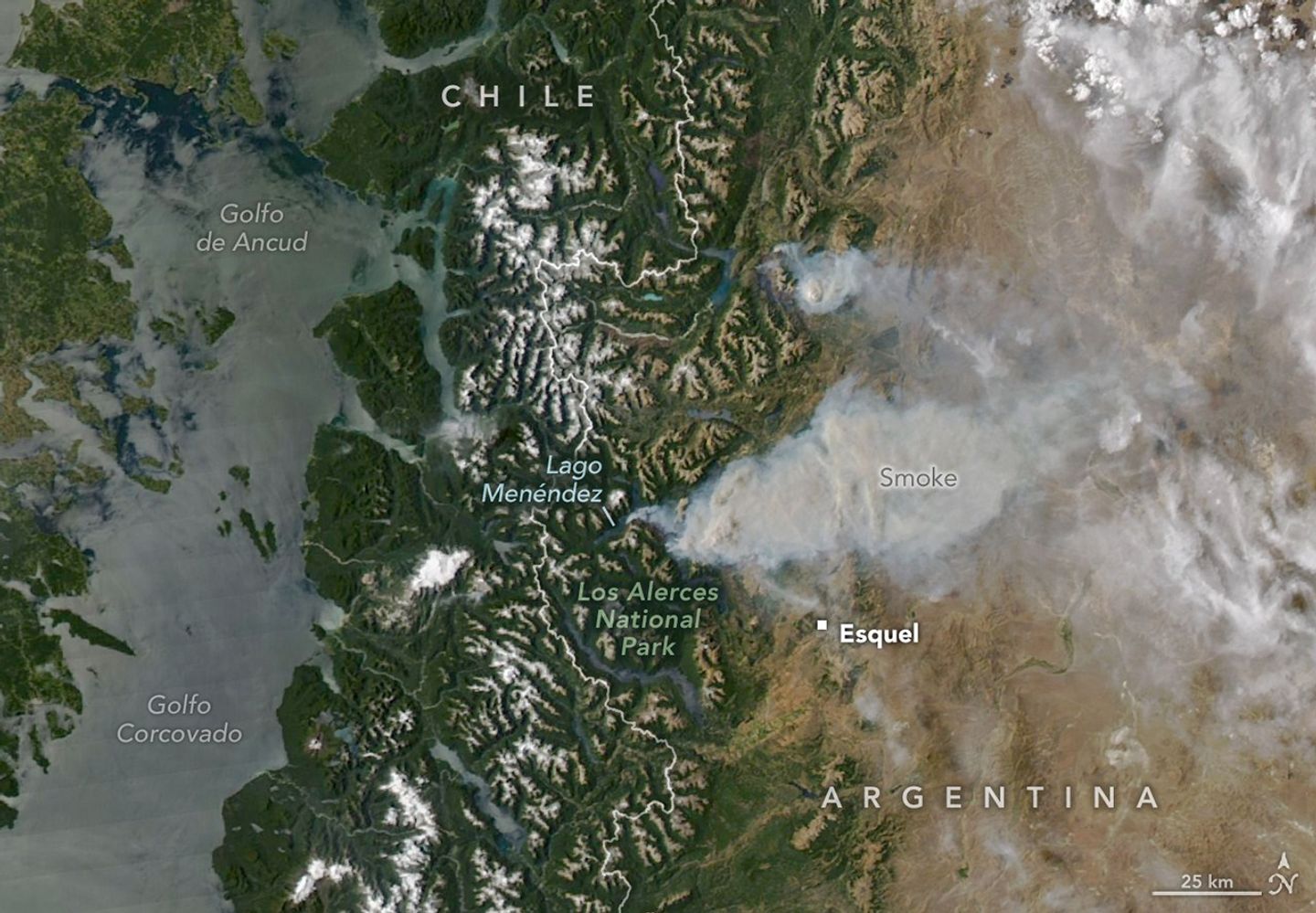
Two thick plumes of gray wildfire smoke spread from Patagonia's forested, snow-capped mountains in the middle of the scene into Argentina's brown, drier plains to the right.
January 8, 2026

Summer is usually peak tourism season in Argentina’s Chubut province, a time when hikers and sightseers arrive to explore glacial lakes and cirques, alpine valleys, and towering forests. In January 2026, however, some visitors to the remote Patagonian region instead found themselves fleeing raging wildland fires.

On January 8, 2026, the MODIS (Moderate Resolution Imaging Spectroradiometer) on NASA’s Aqua satellite captured this image of smoke billowing from two large fires burning in and around Los Alerces National Park, a UNESCO World Heritage site. NASA satellites began detecting widespread fire activity in the area on January 6.

The more southerly blaze was spreading east on ridges between Lago Rivadavia, Lago Futalaufquen, and Lago Menéndez; the more northerly fire was burning on steep hillsides around Lago Epuyén. All of the lakes occupy U-shaped glacial troughs, valleys with unusually flat bases and steep sides carved by glacial and periglacial erosion. Satellite-based estimates from the Global Wildfire Information System indicate that fires charred more than 175 square kilometers (67 square miles) across Patagonia between January 5 and 8.

The ridges are blanketed with temperate Patagonian Andean forest, including sections of Valdivian rainforest, with rare stands of alerce (Fitzroya cupressoides). A type of cypress, these huge, slow-growing conifers are the second-longest-lived trees on Earth, with some surviving for more than 3,600 years. According to UNESCO documents, Los Alerces National Park protects 36 percent of Argentina’s alerce forests, including stands with the greatest genetic variability on the eastern slopes of the Andes. The park’s forests also contain exclusive genetic variants and the oldest individuals in the country.

News outlets and the national park reported challenging weather conditions for firefighters on the ground, who faced high temperatures, low humidity, and strong winds in recent days. Standardized Precipitation Index data from the National Integrated Drought Information System show that unusually dry conditions over the past several months have likely primed vegetation to burn. News outlets reported that at least 3,000 tourists had to be evacuated from a lake resort near Lago Epuyén.

NASA Earth Observatory image by Michala Garrison, using MODIS data from NASA EOSDIS LANCE and GIBS/Worldview. Story by Adam Voiland.

References & Resources

You may also be interested in:

Stay up-to-date with the latest content from NASA as we explore the universe and discover more about our home planet.

Fire Burns Through Olympic Wilderness
2 min read

The Bear Gulch fire spread through dense forest and filled skies with smoke in northwestern Washington state.
Article
Sprawling Gifford Fire Scorches California
3 min read

The fast-growing blaze charred more than 100,000 acres in the span of a week.

Article
Dark Skies Over the Great Basin
5 min read

Far from large urban areas, Great Basin National Park offers unencumbered views of the night sky and opportunities to study…


Article

The post Fire Threatens Rare Forests in Argentina appeared first on NASA Science.

[syndicated profile] earthobservatory_iod_feed

Posted by ldauphin

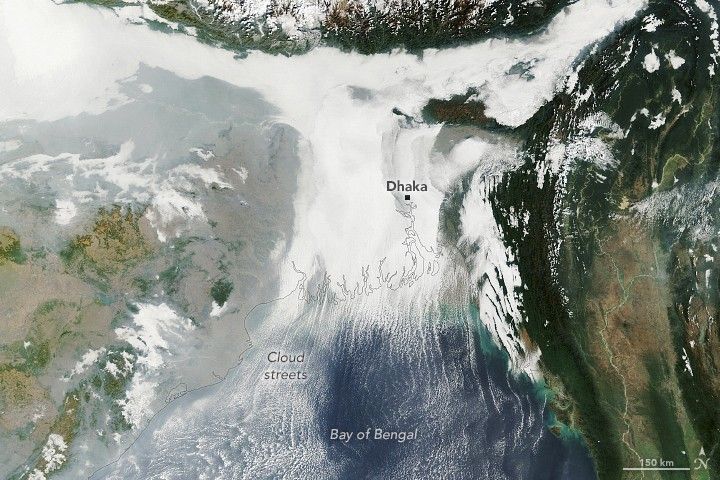
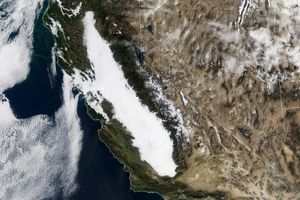
A satellite image of the Ganges Delta shows a T-shaped area of low white clouds. At the bottom, clouds extend over the blue waters of the Bay of Bengal in parallel rows.
January 6, 2026

Winter weather took hold across the Indo-Gangetic Plain in early January 2026, bringing dense fog and cold temperatures to much of the flat, fertile lands that span from Pakistan and northern India to Bangladesh.

This image shows low-lying clouds over the delta on the morning of January 6, captured by the MODIS (Moderate Resolution Imaging Spectroradiometer) on NASA’s Terra satellite. Dense fog, particularly radiation fog, is common this time of year, forming when ground temperatures are cool, winds are light, and moisture is abundant near the surface. The meteorological departments of both Bangladesh and India called for moderate to very dense fog over the region that day amid an ongoing cold wave.

Other relatively low-level clouds extend from the land areas and over the Bay of Bengal. These long, parallel bands of clouds, known as cloud streets, can form when cold air passes over warmer open water, gaining heat and moisture. Rising thermals ascend until they reach a temperature inversion that acts like a lid, forcing the air to roll into long, parallel rotating cylinders. Clouds develop where the air rises, while clear skies appear where the air sinks.

While it appears scenic from above, foggy conditions can pose hazards and snarl daily life for people on the ground. For instance, dense fog early in the month caused major disruptions at the international airport in Dhaka, according to local news reports. Similar disruptions, along with travel delays on roads and railways, were reported in parts of northern, central, and eastern India.

NASA Earth Observatory image by Lauren Dauphin, using MODIS data from NASA EOSDIS LANCE and GIBS/Worldview. Story by Kathryn Hansen.

References & Resources

You may also be interested in:

Stay up-to-date with the latest content from NASA as we explore the universe and discover more about our home planet.

An Unrelenting Tule Fog
4 min read

The right combination of conditions allowed this distinctive low cloud to form in California’s Central Valley for weeks.

Article
New Timing for Stubble Burning in India
5 min read

Scientists say the seasonal crop fires are burning later in the day than in previous years.

Article
Summer Heat Lingers in the West
3 min read

A prolonged high-pressure weather system brought unusually warm September temperatures to British Columbia and the Pacific Northwest.

Article

The post Ganges Delta Under a Winter Shroud of Fog appeared first on NASA Science.

Meltwater Turns Iceberg A-23A Blue

Jan. 8th, 2026 05:01 am
[syndicated profile] earthobservatory_iod_feed

Posted by Michala Garrison

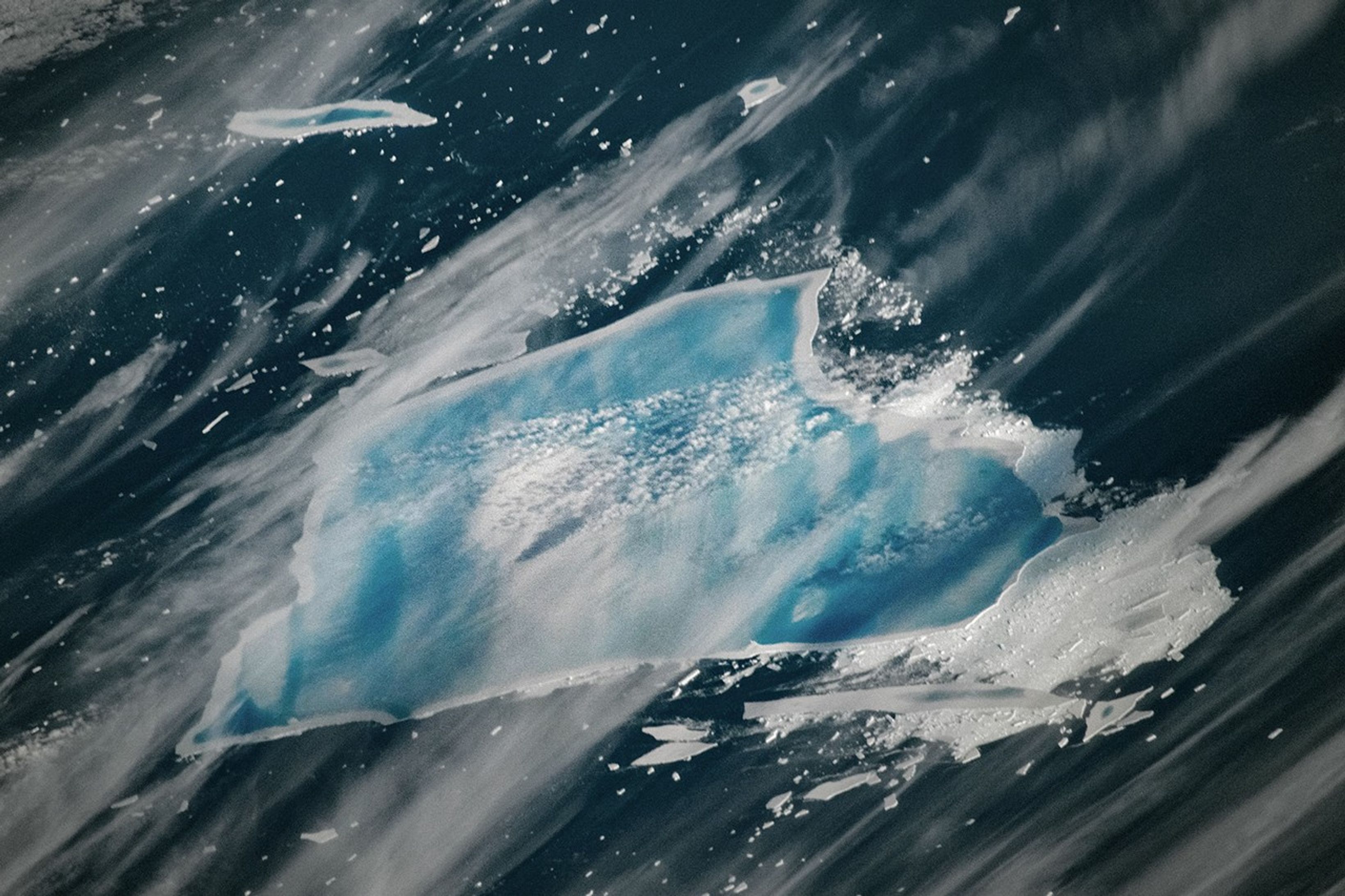
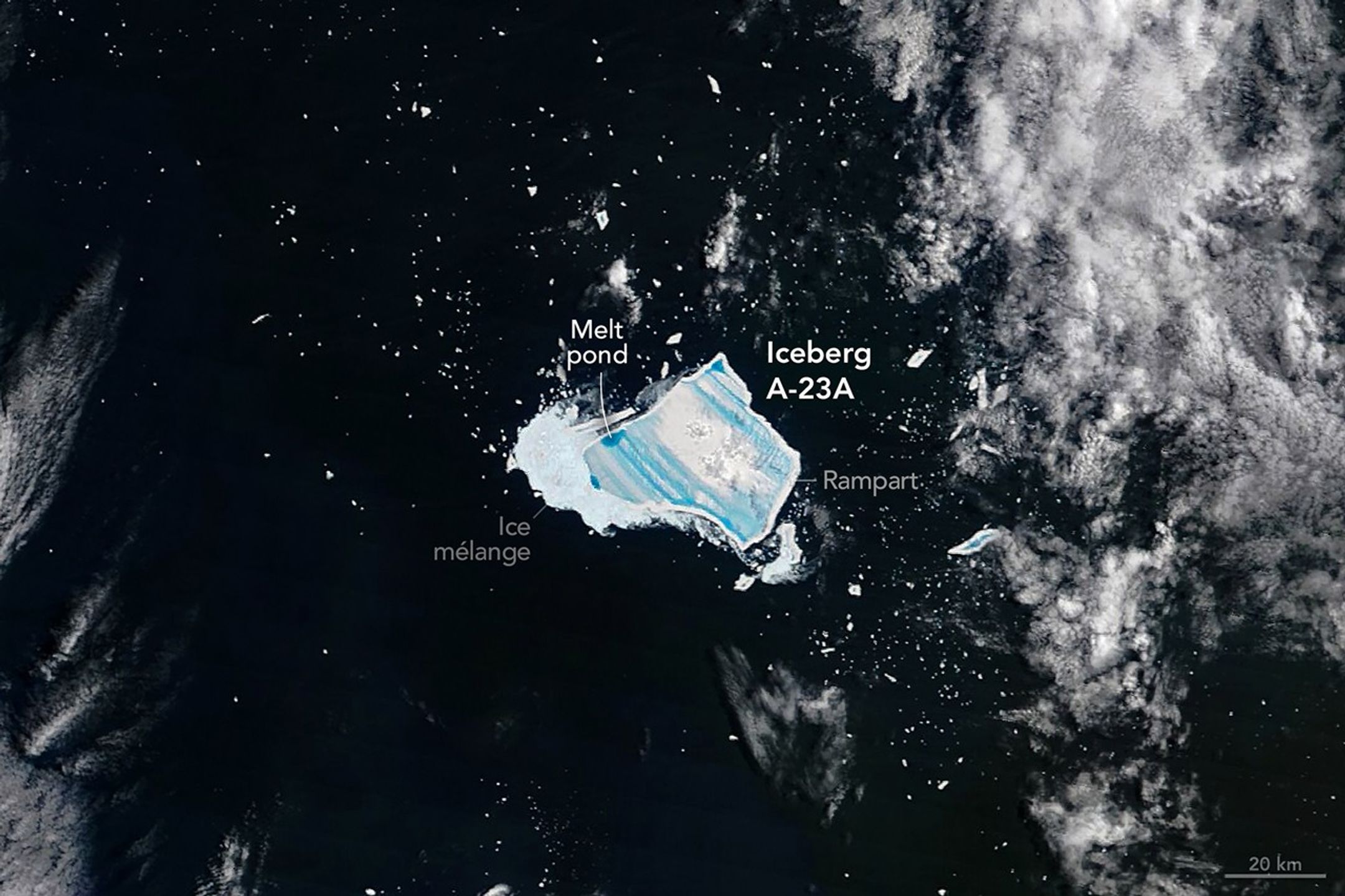
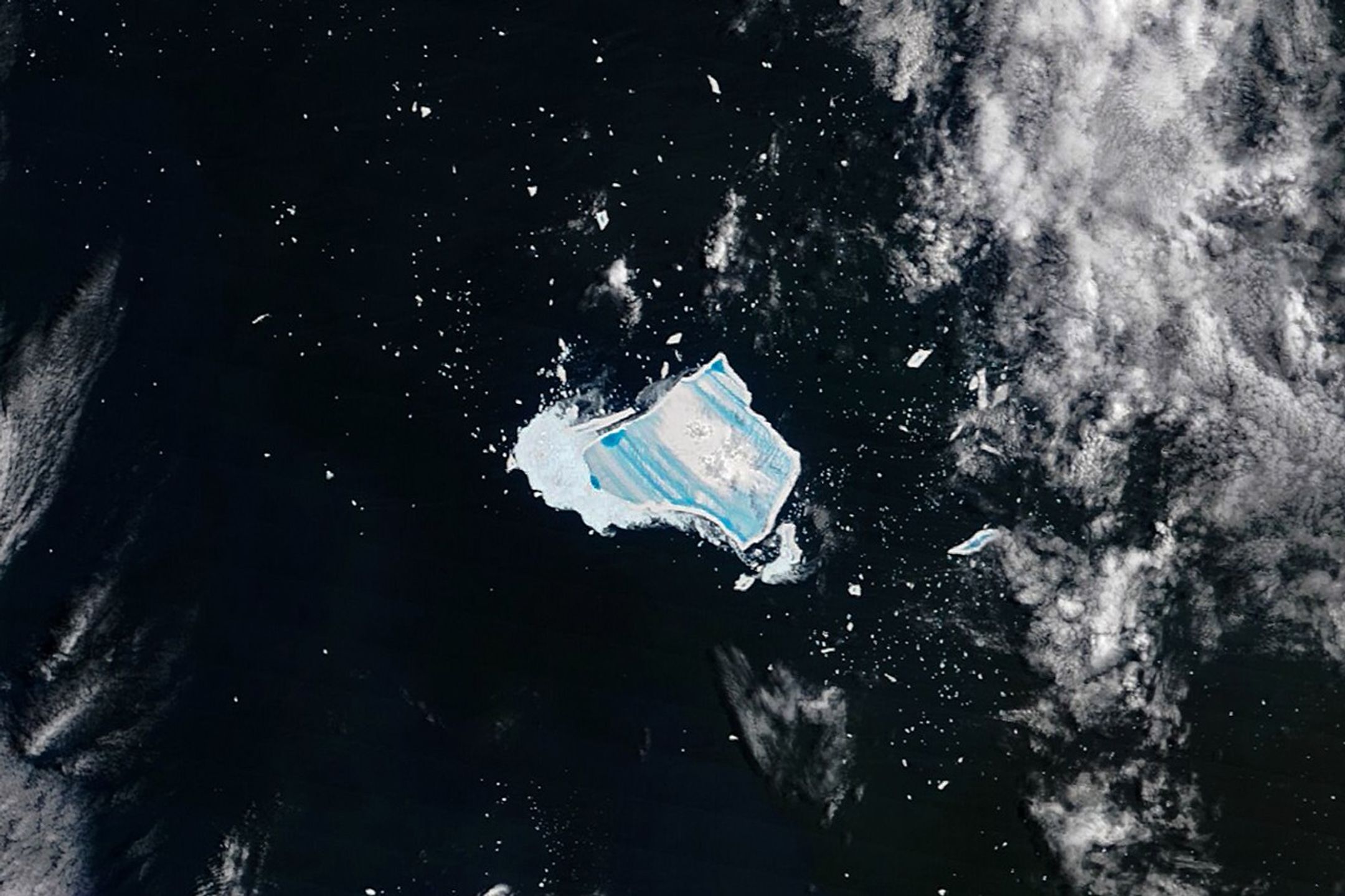
A satellite image captured on December 26, 2025, centers on iceberg A-23A adrift in dark Southern Ocean waters. The iceberg appears as a bright white, roughly rectangular slab with jagged edges and parallel blue stripes across its surface. The blue areas are meltwater ponds. A thick patch of ice fragments known as brash ice is visible along one edge of the main iceberg in an area where meltwater is leaking from it, while patches of small icebergs and clouds are also visible around it.
December 26, 2025

The year that iceberg A-23A first broke away from Antarctica’s Filchner Ice Shelf, Ronald Reagan was president of the United States, and the movie Top Gun was setting box office records. Forty years later, the massive tabular berg—one of the largest and longest-lived bergs ever tracked by scientists—is sopping with blue meltwater and on the verge of complete disintegration as it drifts in the South Atlantic between the eastern tip of South America and South Georgia island.

When it first detached from Antarctica in 1986, the berg was nearly twice the size of Rhode Island—about 4,000 square kilometers. Estimates from the U.S. National Ice Center put the berg’s area at 1,182 square kilometers (456 square miles) in early January 2026, following the breakup of several sizable pieces in July, August, and September of 2025 as it moved into relatively warm summer conditions by December.

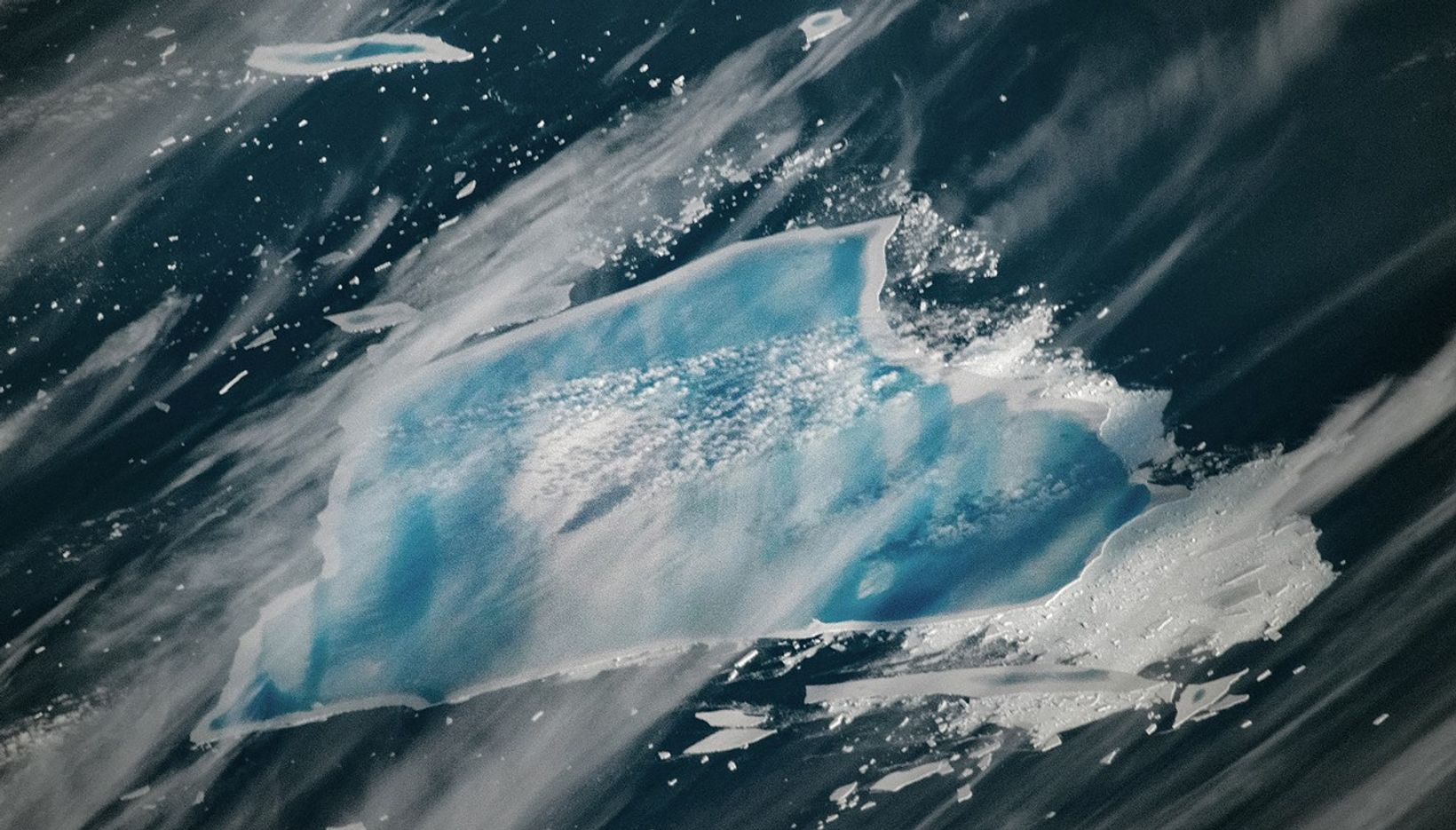
When the MODIS (Moderate Resolution Imaging Spectroradiometer) on NASA’s Terra satellite captured this image of what remained of the waterlogged berg on December 26, 2025, extensive pools of blue meltwater were visible on its surface. Though much smaller than it once was, what remains is still among the largest icebergs in the ocean, covering an area larger than New York City. An astronaut aboard the International Space Station captured a photograph showing a closer view (below) of the iceberg a day later, with an even more extensive melt pool.

The “blue-mush” areas are likely the result of ongoing disintegration events, explained Ted Scambos, a senior research scientist at the University of Colorado Boulder. “You have the weight of the water sitting inside cracks in the ice and forcing them open,” he said. Note also the thin white line around the outer edge of the iceberg seemingly holding in blue meltwater—a “rampart-moat” pattern caused by an upward bending of the iceberg plate as its edges melt at the waterline.

A photograph taken by an astronaut aboard the International Space Station on December 27, 2025, shows a closer view of the iceberg. Striking blue melt ponds cover nearly the surface top of A-23A except for a thin boundary of white along the edge—an area where the ice has warped upward. Wispy clouds run diagonally across the image, partially obscuring the view.
December 27, 2025

The striking linear patterns of blue and white across the berg are likely related to striations that were scoured hundreds of years ago when the ice was part of a glacier dragging across Antarctic bedrock.

“The striations formed parallel to the direction of flow, which ultimately created subtle ridges and valleys on the top of the iceberg that now direct the flow of meltwater,” explained Walt Meier, a senior research scientist at the National Snow & Ice Data Center. “It’s impressive that these striations still show up after so much time has passed, massive amounts of snow have fallen, and a great deal of melting has occurred from below,” added retired University of Maryland Baltimore County scientist Chris Shuman.

The MODIS image suggests that the ailing iceberg has also sprung a leak. The white area to its left may be the result of what Shuman described as a “blowout.” The weight of the water pooling at the top of the towering iceberg would have created enough pressure at the edges to punch through. The blowout may have allowed meltwater to spill tens of meters down to the ocean surface in what researchers call a “freshwater discharge plume,” where it mixed with the mĂ©lange of ice bits floating next to the iceberg.

Scientists say these signs indicate the iceberg could be just days or weeks from disintegrating completely. “I certainly don’t expect A-23A to last through the austral summer,” said Shuman, noting that the season typically brings clearer skies and warmer air and water temperatures—factors that accelerate the disintegration process in an area known among ice experts as a “graveyard” for icebergs. It’s already in water that’s about 3 degrees Celsius and riding currents that are pushing it toward even warmer waters that will eat away at it quickly, added Meier.

Even by Antarctic standards, A-23A has had a long, winding journey full of unexpected chapters that have improved scientists’ understanding of the “megabergs” occasionally released into the Southern Ocean. After grounding in the shallow waters of the Weddell Sea for more than 30 years, A-23A broke free in 2020, then spent several months in a twirling ocean vortex called a Taylor column. It eventually spun away and headed north, nearly colliding with South Georgia island and lodging in shallow waters for several months before escaping into the open ocean, where it has been rapidly breaking apart throughout 2025.

Scientists who have been tracking the berg for their entire careers see its imminent demise as a bittersweet moment. “I’m incredibly grateful that we’ve had the satellite resources in place that have allowed us to track it and document its evolution so closely,” said Shuman. “A-23A faces the same fate as other Antarctic bergs, but its path has been remarkably long and eventful. It’s hard to believe it won’t be with us much longer.”

Even as A-23A fades, other massive bergs are parked or drifting along the Antarctic shoreline. Several, including A-81, B22A, and D15A, are each larger than 1,500 square kilometers and sit waiting for their moment to break free and begin their journey north.

NASA Earth Observatory image by Michala Garrison, using MODIS data from NASA EOSDIS LANCE and GIBS/Worldview. ISS Astronaut photograph ISS074-E-8943 was acquired on December 27, 2025, with a Nikon Z 9 digital camera using a focal length of 500 millimeters. It is provided by the ISS Crew Earth Observations Facility and the Earth Science and Remote Sensing Unit at NASA Johnson Space Center. The image was taken by a member of the Expedition 74 crew. The image has been cropped and enhanced to improve contrast, and lens artifacts have been removed. The International Space Station Program supports the laboratory as part of the ISS National Lab to help astronauts take pictures of Earth that will be of the greatest value to scientists and the public, and to make those images freely available on the Internet. Additional images taken by astronauts and cosmonauts can be viewed at the NASA/JSC Gateway to Astronaut Photography of Earth. Story by Adam Voiland.

References and Resources

You may also be interested in:

Stay up-to-date with the latest content from NASA as we explore the universe and discover more about our home planet.

A Giant Iceberg’s Final Drift
3 min read

After a long, turbulent journey, Antarctic Iceberg A-23A is signaling its demise as it floats in the South Atlantic.

Article
Antarctic Iceberg Downsizes
3 min read

Iceberg A-23A continued to lose sizable pieces of ice during the 2025 austral winter, but it remained the planet’s largest…

Article
Antarctic Sea Ice Saw Its Third-Lowest Maximum
2 min read

Sea ice around the southernmost continent hit one of its lowest seasonal highs since the start of the satellite record.

Article

The post Meltwater Turns Iceberg A-23A Blue appeared first on NASA Science.

[syndicated profile] earthobservatory_iod_feed

Posted by ldauphin

June 2022-July 2023

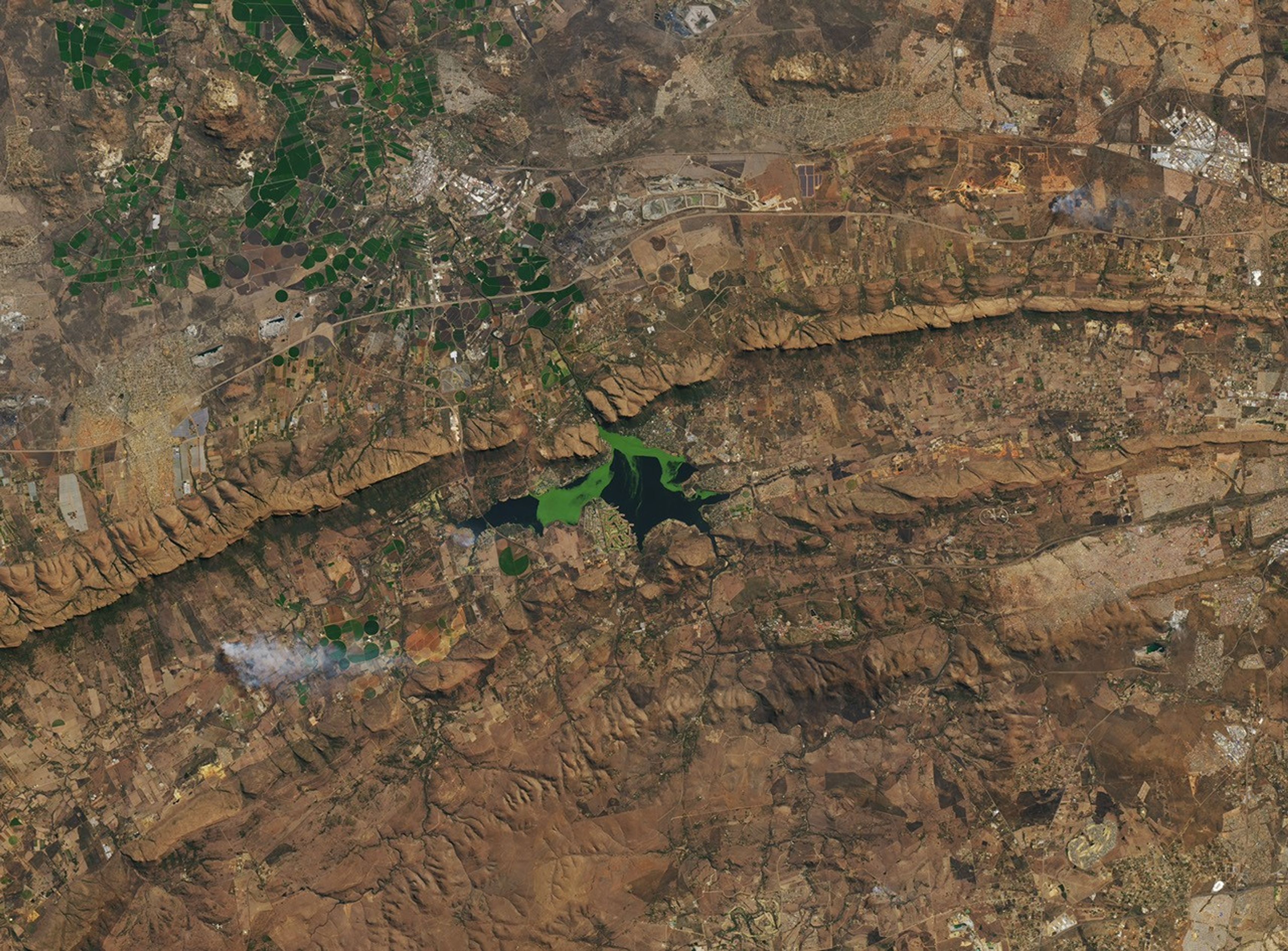
On clear days in Hartbeespoort, South Africa, satellite images often reveal a reservoir with shades of deep blue interrupted by drifting patches of vivid green. Over the years, these shifting features have included algae blooms—which can affect water quality, ecosystems, and nearby human communities—along with several types of invasive aquatic plants.

In this animation, from June 2022 to July 2023, aquatic plants proliferate, move around the reservoir, and then fade. The animation is composed of images from Harmonized Landsat and Sentinel-2 (HLS), a NASA product that combines imagery from the NASA/USGS Landsat 8 and Landsat 9 satellites and the European Space Agency’s Sentinel-2A, 2B, and 2C satellites.

The green masses can also contain varying amounts of algae, an umbrella term for photosynthetic organisms that live in water, encompassing everything from single-celled cyanobacteria to seaweed. They play a vital role in maintaining healthy ecosystems. But when colonies of algae spread too widely or release harmful toxins, they can threaten the very environments they support. These colonies are known as harmful algal blooms, or HABs.

Some HABs are toxic and often are part of a process called eutrophication. Eutrophication begins when there are too many nutrients in an ecosystem—because of agricultural runoff and other inputs—leading to a rapid growth of algae.

“It’s like having a garden,” said Bridget Seegers, a NASA scientist who studies cyanobacteria in freshwater ecosystems. “If you add a lot of nutrients, you’re going to have a lot of growth.”

Eventually, the algae die off. As decomposers break down the dead algae, they consume oxygen, which can lead to hypoxia and the formation of dead zones.

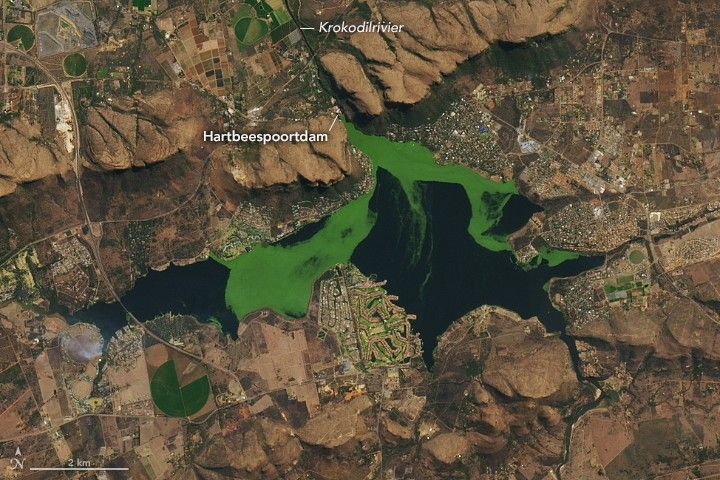
A satellite image of a mostly brown landscape features a dark-blue reservoir partially covered by bright green algae in the north and center.
August 10, 2022

Such conditions have been documented at the Hartbeespoortdam (Hartbeespoort Dam) reservoir, located about 25 kilometers (16 miles) west of Pretoria and used primarily for recreation and irrigation. It also hosts large mats of invasive water hyacinths and, more recently, the invasive plant Salvinia minima. While these aquatic plants do not produce toxins, they do contribute to eutrophication when they die and decompose.

Harmful algal blooms can affect ecosystem health and human lives and livelihoods. In April 2023, South African authorities linked a large fish kill in Hartbeespoort to low oxygen levels caused by excessive algal growth. More broadly, HABs in drinking water reservoirs can reduce water availability and raise water treatment costs, while swimming in HAB-infested waters can cause rashes, and pets or livestock that drink it may fall ill or die.

One 2022 paper published in Remote Sensing examined algae in the reservoir from 1980 to 2020 using Landsat data. “This is a reservoir that has always been monitored heavily by the local department of water resources,” said Adam Ali, the lead author of the paper. The research used satellite data to provide a big-picture view of conditions across the entire reservoir over long time scales. Using 40 years of Landsat data, the researchers found that the biggest drivers of algal growth were total phosphorus content—a nutrient found in runoff—and water temperature, with blooms typically expanding in the warm summer months and subsiding in the winter.

They also identified key trends over space and time. Algal productivity was higher near Krokodilrivier (Crocodile River) inflows and in the western part of the reservoir due to golf course runoff and restricted water circulation, demonstrating how HABs are influenced by runoff and river inputs. Large blooms occurred between 1982 and 1986, when total phosphorus levels were high. A bioremediation program in the late 1980s succeeded in limiting algae growth, but after funding ended in the late 1990s, harmful algal blooms spiked again in the early 2000s.

To track algae from space, the researchers analyzed the water’s color by measuring different wavelengths of light. From this, they estimated the concentration of chlorophyll-a, a common pigment in algae, and used these values to approximate algae biomass over time. Although water samples remain necessary to confirm that a bloom is harmful, satellite data can help scientists understand the drivers of harmful algal blooms, especially in remote regions where regular ground monitoring is expensive and time intensive.

New and forthcoming NASA missions promise to advance space-based water quality monitoring. The next Landsat satellite is expected to measure wavelengths specifically designed to detect HABs. NASA’s PACE (Plankton, Aerosol, Cloud, ocean Ecosystem) mission, launched in 2024, collects data in hundreds of precise wavelength bands in the visible spectrum, which can help scientists identify the type of algae that comprise a certain bloom—a key factor in determining toxicity. Given PACE’s spatial resolution, the data is most useful in coastal areas or larger inland water bodies. Ali is working with researchers at NASA Ames to integrate PACE into future studies.

Editor’s note: This story was updated on January 13, 2026, to note the presence of the plant Salvinia minima.

Animation by Ross Walter/Landsat Science Office Support, using data from the Harmonized Landsat and Sentinel-2 (HLS) product. HLS is funded by NASA and is a deliverable of the Satellite Needs Working Group (SNWG), an interagency effort of the U.S. Government dedicated to identifying and addressing Earth observation needs across U.S. civilian federal agencies. Still image by Lauren Dauphin/NASA Earth Observatory using Landsat data from the U.S. Geological Survey. Story by Madeleine Gregory/Landsat Science Office Support.

References & Resources

You may also be interested in:

Stay up-to-date with the latest content from NASA as we explore the universe and discover more about our home planet.

Iraq Reservoirs Plunge to Low Levels
5 min read

A multi-year drought has put extra strain on farmers and water managers in the Middle Eastern country.

Article
Reservoirs Dwindle in South Texas
3 min read

Drought in the Nueces River basin is reducing reservoir levels, leaving residents and industry in the Corpus Christi area facing…

Article
Lost Towns of the Quabbin
4 min read

Forests play a key role in filtering the waters of a reservoir in central Massachusetts that’s home to submerged towns…

Article

The post Plants and Algae Swirl Across a South African Reservoir appeared first on NASA Science.

Reaching the Precipice in Angola 

Jan. 6th, 2026 05:01 am
[syndicated profile] earthobservatory_iod_feed

Posted by ldauphin

This satellite image centers on the serrated edge of the Huila plateau in Angola. The sheer cliff wall forms a rough C shape and is highlighted by dark shadows and a band of green vegetation. The lowlands to the left are tan-colored arid coastal plains, and the more-temperate plateau on the right side is greener.
June 19-20, 2025

In southwestern Angola, an expanse of coastal plains comes to an abrupt end at a natural barrier. The HuĂ­la plateau soars above the lowlands to elevations of around 2,300 meters (7,500 feet). The sharp transition results in dramatic landscapes and a sudden change from an arid environment to more-temperate climes.  

The serrated edge of the HuĂ­la plateau zigzags through this image, which is a mosaic of scenes acquired on June 19 and 20, 2025, with the OLI-2 (Operational Land Imager-2) and OLI on the Landsat 9 and Landsat 8 satellites, respectively. Areas around the plateau’s edges appear green with vegetation. But the landscape tends to look much browner by late September, at the end of the region’s dry season, during which almost no rain falls.  

This topography is part of the Great Escarpment of southern Africa, a 5,000-kilometer-long feature running roughly parallel to the continent’s edge. From Angola, it extends south through Namibia, across South Africa, and then northeast into Zimbabwe and Mozambique. The image below, acquired with the VIIRS (Visible Infrared Imaging Radiometer Suite) on the Suomi NPP satellite, shows a longer segment of the escarpment in Angola.  

A satellite image of southwestern Angola shows light-colored coastal desert to the left and a darker plateau to the right. These are separated by a jagged boundary tinged with green, part of the Great Escarpment of southern Africa. The Atlantic Ocean, mostly cloud-covered, runs along the left edge of the image.
June 20, 2025

Scientists believe the escarpment formed after the breakup of the supercontinent Gondwana in the Jurassic period. Since then, erosion has worn away at the continental margin such that the escarpment now sits 50 to 200 kilometers (30 to 120 miles) back from the coast.   

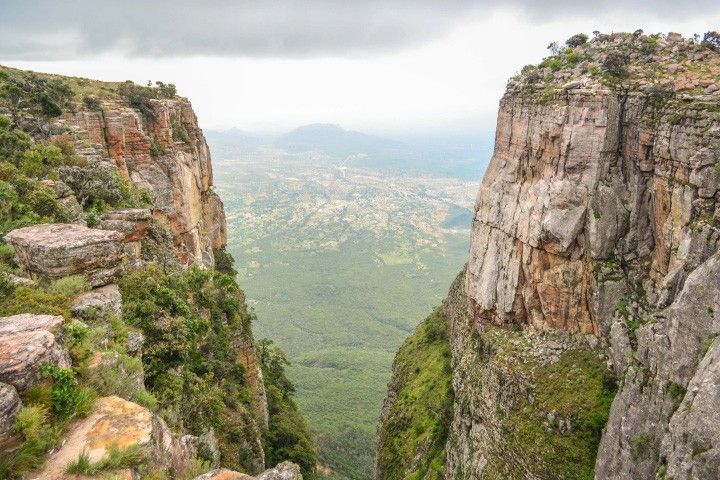
This Angolan section of the escarpment features dizzying, yet beautiful, landscapes. Tundavala Gap, a gouge eroded into the cliff line (below), is one of the most iconic with its well-framed view of the plains below. The precipice also presents a substantial obstacle to transportation. A stretch of the Namibe-Lubango Road overcomes this challenge with a series of scenic hairpin turns climbing to Serra da Leba pass near the town of Leba.  

Sheer cliff walls on the right and left sides of this photograph make a V shape in the foreground. Some light green shrubs grow from cracks in the rock. The ground visible in the opening between the cliffs is far below.
March 11, 2014

Lubango, one of Angola’s largest cities, occupies a valley on the HuĂ­la plateau. In addition to its remarkable natural surroundings, the city boasts a diverse mix of cultures, striking architecture, and a wide variety of locally produced foods.  

NASA Earth Observatory images by Wanmei Liang, using Landsat data from the U.S. Geological Survey, and VIIRS data from NASA EOSDIS LANCEGIBS/Worldview, the Suomi National Polar-orbiting Partnership, and the Joint Polar Satellite System (JPSS). Photo of Tundavala Gap © jbdodane.com. Story by Lindsey Doermann. 

References & Resources 

You may also be interested in:

Stay up-to-date with the latest content from NASA as we explore the universe and discover more about our home planet.

Breaking New Ground in Mekele  
5 min read

Researchers are using satellites to study development patterns in this fast-growing city in Ethiopia.

Article
Rewilding South Africa’s Greater Kruger
5 min read

Satellites are helping land managers track ecological shifts as reserves reconnect and landscapes return to a more natural state.

Article
Rapid Growth for Benin City
5 min read

Satellites have tracked development over the decades as a small city in southern Nigeria grew to more than 2 million…

Article

The post Reaching the Precipice in Angola  appeared first on NASA Science.

[syndicated profile] earthobservatory_iod_feed

Posted by Michala Garrison

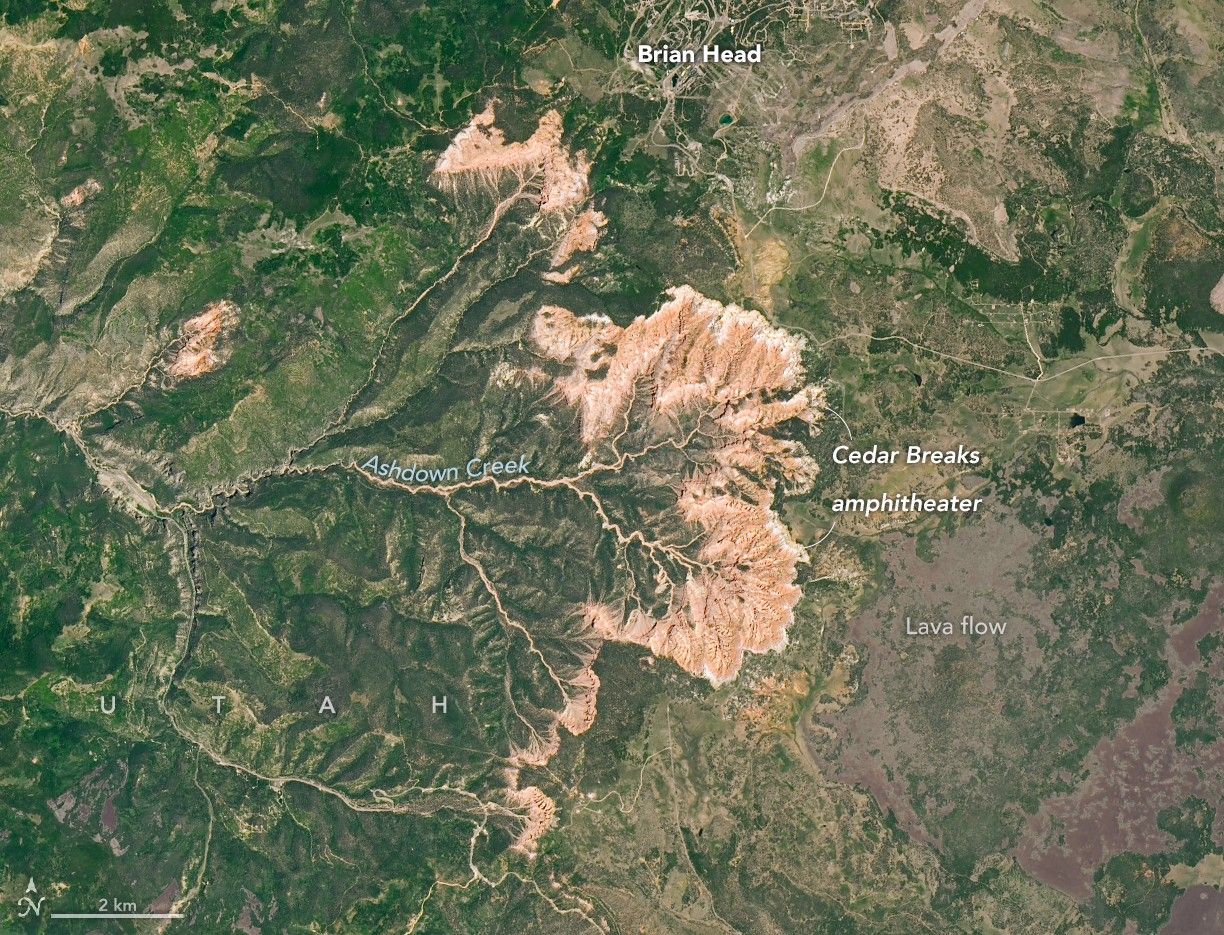
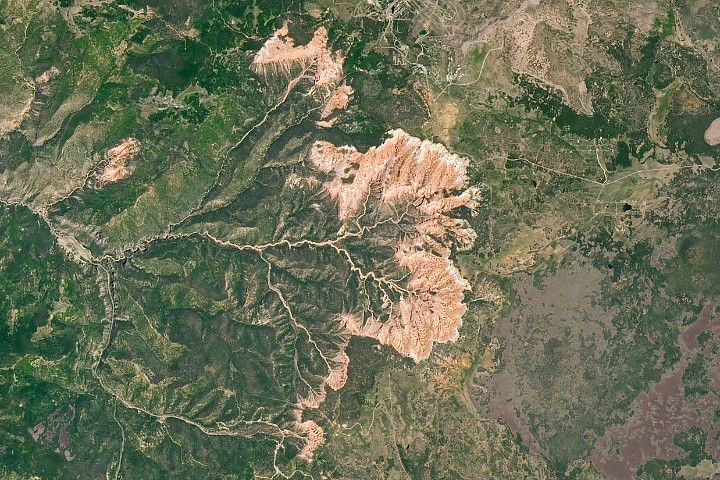
A Landsat image is centered on an orange, amphitheater-shaped escarpment cutting into darker green, forested terrain at Cedar Breaks National Monument in southwestern Utah. Light-colored and orange cliffs and ridges form a semicircular rim, with deeply eroded drainages radiating westward. A black lava flow with little vegetation is visible east of the escarpment. Trails from Brian Head, a nearby mountain and ski area, are visible to the north.
June 18, 2025

When people stand at the rim of the amphitheater in Utah’s Cedar Breaks National Monument and look down on an otherworldly landscape of multicolored rock spires, pinnacles, and other geologic oddities, they’re looking across tens of millions of years of Earth’s history. The same can be said when viewing the bowl-shaped escarpment from space.

The OLI-2 (Operational Land Imager-2) on Landsat 9 captured this view of the amphitheater’s semicircular rim and deeply eroded drainages on June 18, 2025. The erosive power of water from Ashdown Creek and several tributaries, along with relentless physical and chemical weathering, is evident in the many channels, cliffs, and canyons that radiate outward from the rim and define the escarpment and amphitheater.

The feature’s striking rock formations are composed of sedimentary rock layers laid down roughly 50 to 25 million years ago within a basin that, at times, held a large body of water called Lake Claron. Many of the amphitheater’s limestone layers began as sediments that settled on its lakebed as carbonate-rich muds.

Differences in rock type and color, evident in the layering seen in ground photographs and to a degree in Landsat images, reflect differences in environmental conditions during deposition. Lake Claron, for instance, was sometimes quite deep, but during dry periods it was shallow or nonexistent. In wet conditions, iron in muddy sediments was scarce or had too little exposure to oxygen to oxidize, or rust, leaving the resulting rock white or gray. During drier periods, iron in sediments had greater exposure to oxygen, forming minerals that turned layers red and orange. 

After deposition, slow-moving tectonic forces lifted all these rock layers upward, ultimately putting them at the top of the Grand Staircase—an immense sedimentary sequence that stretches south from Cedar Breaks and Bryce Canyon, through Grand Staircase-Escalante National Monument and Zion Canyon, and finally into the Grand Canyon. Younger rock layers are found at the top of the sequence and older layers at the bottom.

The rim at Cedar Breaks, the top of the staircase, sits about 10,000 feet (3,000 meters) above sea level, roughly 7,000 feet above the Colorado River in the Grand Canyon. The high elevation influences everything from the weather to the plants and animals that live there. Winters are long, cold, and snowy, with nearby Brian Head seeing 30 feet (10 meters) of snowfall each year on average.

While the cool temperatures and short growing season are an impediment to many types of vegetation, the slow-growing and notoriously long-lived bristlecone pines found along the escarpment’s rim use the harsh conditions to their advantage. Slow growth makes their wood unusually dense, which protects the trees from disease and insects. Likewise, their ability to survive in thin soils, on mostly barren limestone outcrops where little else can grow, protects them from wildfires. Some of the oldest bristlecones in the monument are more than 1,700 years old.

Sitting atop the sedimentary layers, signs of a more volcanically active period also appear in the image. The dark basaltic lava flows visible to the east of the amphitheater formed between 5 million and 10,000 years ago, when several volcanoes on the Markagunt Plateau erupted regularly. Areas of soft, gray rock around the summit of Brian Head—now the site of a ski resort—formed when pyroclastic flows left deposits of tuff strewn across the landscape.

NASA Earth Observatory images by Michala Garrison, using Landsat data from the U.S. Geological Survey. Story by Adam Voiland.

References & Resources

You may also be interested in:

Stay up-to-date with the latest content from NASA as we explore the universe and discover more about our home planet.

Browns Canyon National Monument
2 min read

The remote and rugged landscape in central Colorado is known for outdoor recreation by day and exceptional stargazing by night.

Article
Dark Skies Over the Great Basin
5 min read

Far from large urban areas, Great Basin National Park offers unencumbered views of the night sky and opportunities to study…

Article
Fire Burns Through Olympic Wilderness
2 min read

The Bear Gulch fire spread through dense forest and filled skies with smoke in northwestern Washington state.

Article

The post An Amphitheater of Rock at Cedar Breaks appeared first on NASA Science.
Lake Eyre Blushes

Jan. 2nd, 2026 05:01 am
[syndicated profile] earthobservatory_iod_feed

Posted by ldauphin

A satellite image centers on Lake Eyre in the Australian outback. Two large lobes in the southern part of the lake contain water. The one to the left appears green, and the one on the right is a rusty red. The lakebed to the north is bright and appears dry. The surrounding desert appears in shades of orange and tan.
December 15, 2025

The year 2025 was extraordinary for Lake Eyre (also called Kati Thanda-Lake Eyre) in South Australia. Water started flowing into the often-dry, salty plain at the continent’s lowest point in early May after torrential rains in Queensland flooded several rivers that drain toward it. The lake continued to fill in the ensuing months, reaching levels rarely seen.

The lake turned a corner in early October, spring in Australia. Tributaries feeding the basin slowed to a trickle, and evaporation started outpacing inflow from rivers, according to local observers. By the start of December, the Lake Eyre Yacht Club reported that the rivers had dried up, temperatures had warmed with the arrival of summer, and lake levels were dropping rapidly.

As it dried, Lake Eyre displayed more striking changes visible to satellites. The OLI (Operational Land Imager) on Landsat 8 acquired this natural-color image of Lake Eyre on December 15, 2025. The two deepest parts of the lake—Belt Bay and Madigan Gulf—still contained some water, which took on greenish and reddish hues, respectively. (From closer vantage points, Madigan Gulf can appear pink and even orange.)

As Lake Eyre evaporates, the remaining water becomes increasingly saline. Halophilic, or salt-loving, microorganisms thrive in these waters, enough to alter its color over large areas. Direct water samples are needed to identify what microbes are present in Lake Eyre. Past analyses have detected Dunaliella salina algae in samples, and studies of different pink-colored lakes have found the same algae, along with populations of other halophilic bacteria and archaea. Many of these species are known to produce pigmented compounds such as carotenoids that are colored pink, orange, or red.

Salt-loving algae and bacteria are sensitive to salinity levels and other environmental factors. Different conditions in Belt Bay and Madigan Gulf may support different microbial mixes, accounting for their contrasting colors. A similar-looking contrast between greenish and reddish waters sometimes occurs in Utah’s Great Salt Lake, where a causeway prevents water in the lake’s north and south arms from mixing. Varied salinity, water depth, and microbe populations also affect water color in San Francisco Bay-area salt ponds.

Just how long water will remain in Lake Eyre will depend largely on summer heat and evaporation rates. As an endorheic lake, it has no outflow, and this part of the outback receives very little rain. After complete fills of the lake, for example in 1950, 1974, and 1984, it took up to two years to dry out again.

NASA Earth Observatory image by Lauren Dauphin, using Landsat data from the U.S. Geological Survey. Story by Lindsey Doermann.

References & Resources

You may also be interested in:

Stay up-to-date with the latest content from NASA as we explore the universe and discover more about our home planet.

Cooper Creek Replenishes Lake Eyre
3 min read

Another major tributary reached the Australian outback lake in 2025, extending the months-long flood of the vast, ephemeral inland sea.

Article
An Explosive Beginning for Lake Bosumtwi
5 min read

An asteroid that struck the rainforest in Africa around 1 million years ago created Ghana’s only natural lake.Â

Article
Sweeping Vistas Above the Great Salt Lake
3 min read

The lake in northwestern Utah displays striking red and green waters that contrast with the region’s surrounding desert, salt flats,…

Article

The post Lake Eyre Blushes appeared first on NASA Science.
The Galaxy Next Door

Jan. 1st, 2026 05:01 am
[syndicated profile] earthobservatory_iod_feed

Posted by ldauphin

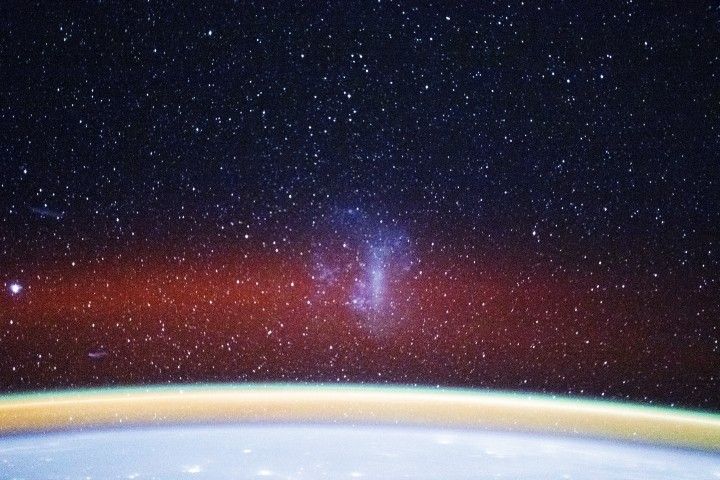
A photo taken from the International Space Station looks out over Earth’s horizon into space. Many white points of light appear against a dark background. A bright blurry area near the center of the photo is the Large Magellanic Cloud, a nearby dwarf galaxy. Earth’s bright blue horizon and layers of bright yellow and faint orange airglow arc across the bottom of the image.
November 28, 2025

From the International Space Station, astronauts gaze upon a vast sea of stars, the view almost entirely unencumbered by Earth’s atmosphere. Their perspective on outer space, as it turns out, extends beyond the Milky Way.

Located about 160,000 light-years away, the Large Magellanic Cloud (LMC) is an irregular dwarf galaxy consisting of billions of stars. It appears as a bright smudge in this photo, which was taken by an astronaut aboard the station on November 28, 2025. Arcing across the bottom of the image is Earth’s limb, along with yellow, green, and diffuse red layers of airglow.

Skywatchers on Earth can also see this nearby galaxy from the Southern Hemisphere and from low Northern Hemisphere latitudes without optical aid. It is part of our Local Group, a galactic neighborhood about 10 million light-years across containing the Milky Way, Andromeda, and Triangulum galaxies, plus around 50 dwarf galaxies, including the LMC.

Although this parcel of space is visible with little or no technology, sophisticated instruments developed by NASA and others have captured extraordinary views of the LMC. Images from the Hubble Space Telescope, the Spitzer Space Telescope, and a combination of missions show its stars and nebulae in different wavelengths.

The LMC is a hotbed of star formation, giving astronomers excellent opportunities to study the life cycle of stars and space dust. A supernova in 1987—the nearest observed in hundreds of years—offered a close-up look at the death of a star and its aftermath. The powerful explosion blazed with the power of 100 million Suns for several months, and scientists observed a bright ring of gas around the exploded star for decades.

More recently, astronomers studied how vast quantities of dust were being forged in the supernova’s glowing remains. A portion of the material may be the source of astronomical new beginnings as building blocks for stars and planets.

Astronaut photograph ISS073-E-1198989 was acquired on November 28, 2025, with a Nikon Z9 digital camera using a focal length of 50 millimeters. It is provided by the ISS Crew Earth Observations Facility and the Earth Science and Remote Sensing Unit at NASA Johnson Space Center. The image was taken by a member of the Expedition 73 crew. The image has been cropped and enhanced to improve contrast, and lens artifacts have been removed. The International Space Station Program supports the laboratory as part of the ISS National Lab to help astronauts take pictures of Earth that will be of the greatest value to scientists and the public, and to make those images freely available on the Internet. Additional images taken by astronauts and cosmonauts can be viewed at the NASA/JSC Gateway to Astronaut Photography of Earth. Story by Lindsey Doermann.

References & Resources

You may also be interested in:

Stay up-to-date with the latest content from NASA as we explore the universe and discover more about our home planet.

Nighttime Over the Eastern Pacific
2 min read

A long-exposure photo taken from low Earth orbit captured the brilliant illumination coming from airglow, lightning, and stars.

Article
A Northwest Night Awash in Light
3 min read

The glow of city lights, the aurora, and a rising Moon illuminate the night along the northwest coast of North…

Article
Five Minutes in Orbit
3 min read

An astronaut captured a moonrise—and much more—in a series of photos taken from the International Space Station.

Article

The post The Galaxy Next Door appeared first on NASA Science.
Snowflake Challenge #6

Jan. 12th, 2026 06:38 pm
soricel: (Default)
[personal profile] soricel
My ten favorite non-DW blogs:

Winnie Lim

Annie Mueller

Keenan

Tracy Durnell

Ava

Tiramisu

Draft Four (ugh, Substack, sorry...it's the only one I subscribe to)

Sasha Frere Jones (I don't actually read this regularly, but I always look forward to reading his end-of-year reflection compilations, heavy as they are)

And, because I can't think of two more...two places where I look for non-DW blogs:

Ye Olde Blogroll

People and Blogs